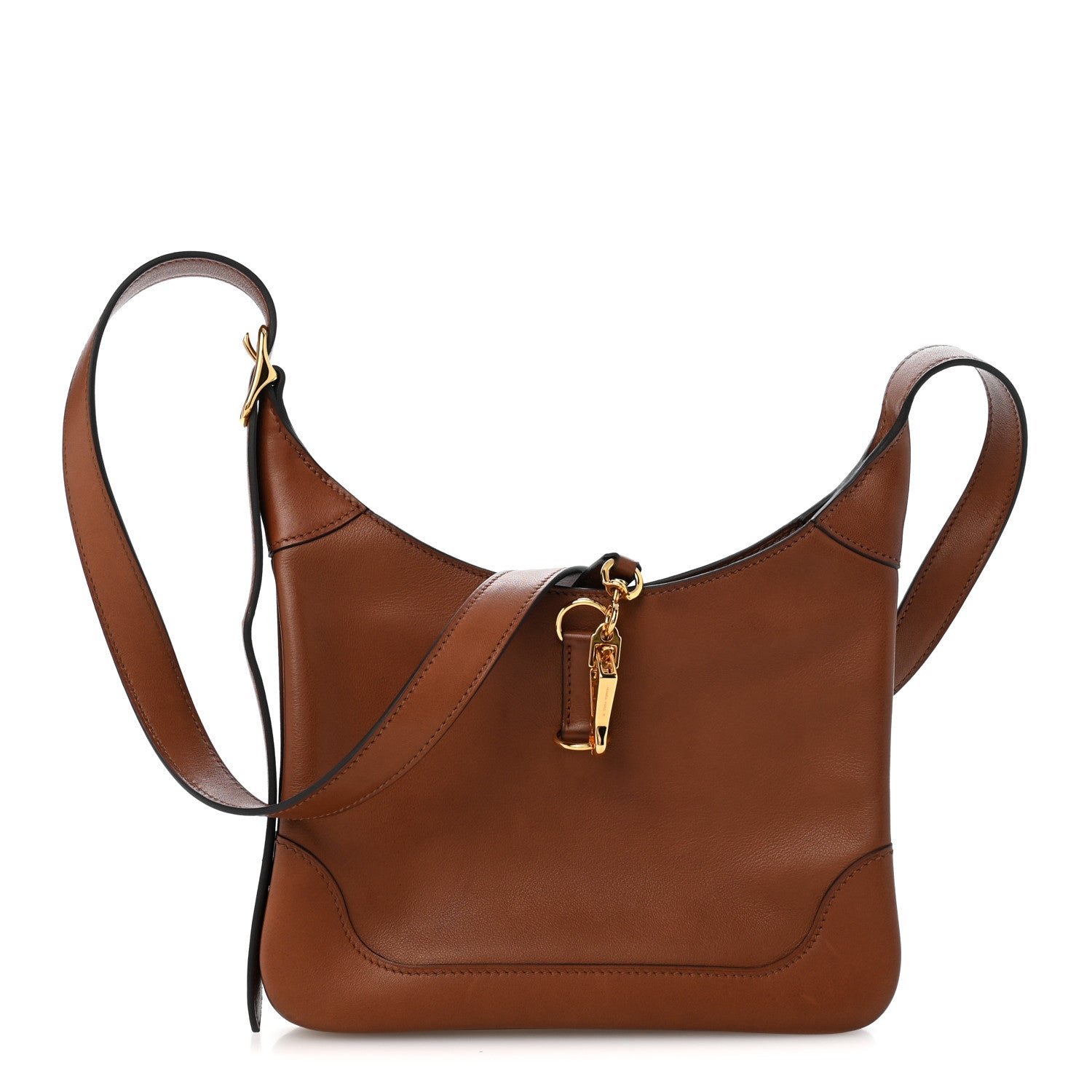
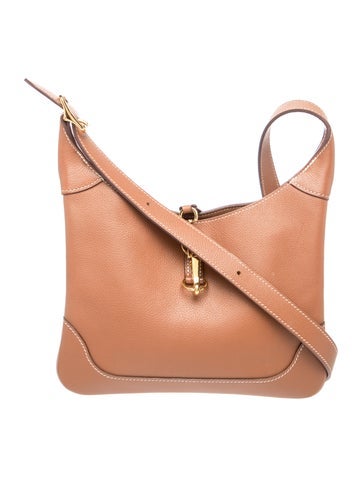
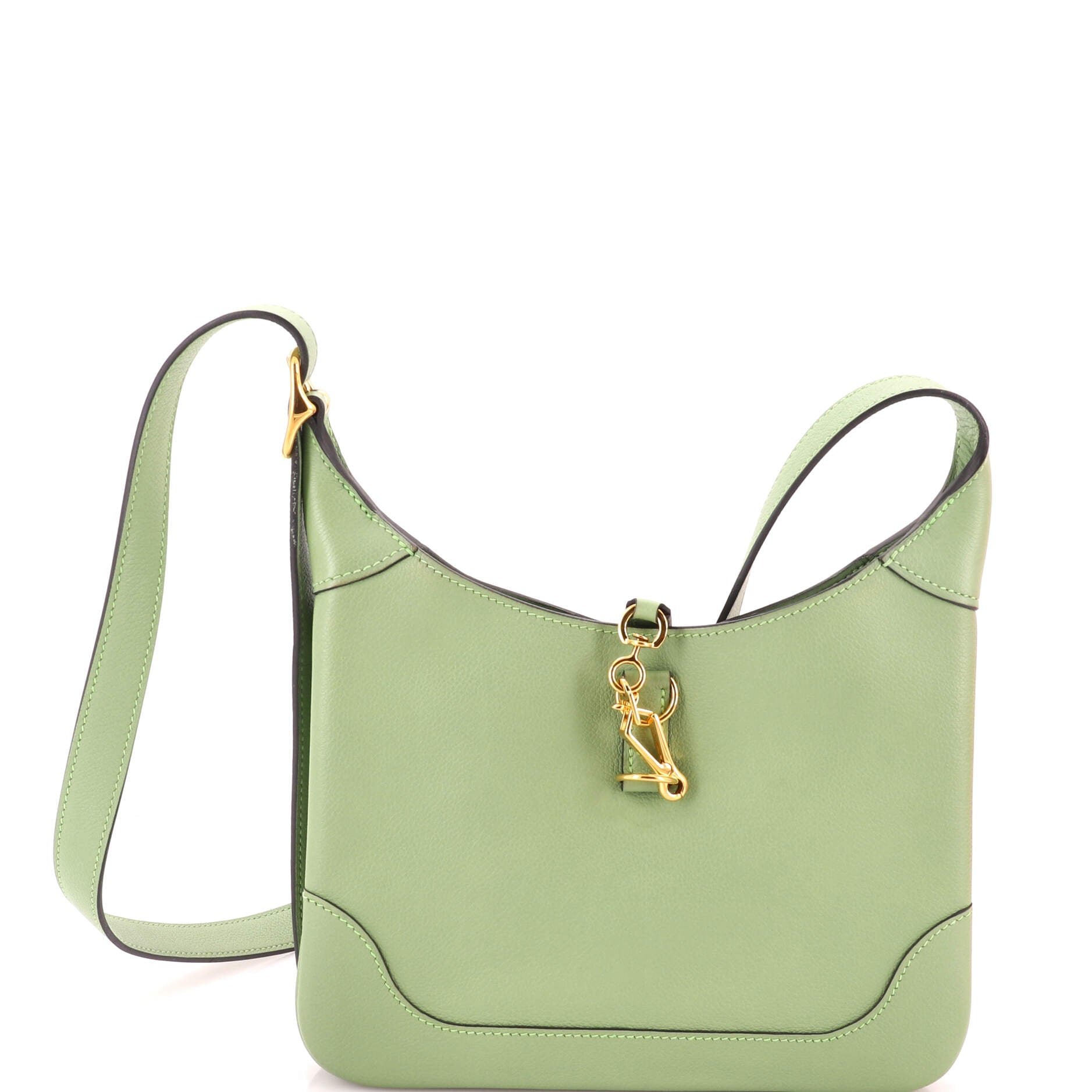
The Hermès Trim is one of those bags that makes more sense once you stop treating it like a headline model and start looking at how it sits on the body. The original Trim is a slim shoulder bag with almost no visual noise. Trim II adds the base and zipper most people want for daily use. Trim Duo 24 takes the same family idea and turns it into a compact two-compartment bag that feels much more current.
That difference matters because the Trim name covers bags that behave very differently. A classic Trim II 35 is a shoulder bag first. A Duo 24 can sometimes work crossbody. A vintage Trim I is flatter and leaner than both. If you shop the family as if every version works the same way, you will buy the wrong one.
History & Revival
Most reliable secondary sources place the Trim's design in 1958. Those same sources usually describe the bag as an Hermès conversion of a practical equestrian form, often compared to a horse trough or feed bag, into an everyday shoulder bag. Whether you like that origin story or not, it explains the line well: the Trim has always been more about shape and use than about visible branding.
The bag's public image also owes a lot to Jacqueline Kennedy. She was photographed carrying a Trim-style bag often enough that buyers still call it "the Jackie." That nickname stuck in collector circles, but it is still just a nickname.
One thing worth keeping clean in the article record: we did not find a reliable Hermès primary source naming the original designer. Plenty of resale and editorial sites repeat the history, but named-designer claims are weak unless Hermès itself says so.
Why the Trim came back
Post-2020 references to the Trim usually describe the bag as a redesign or revival, not as a brand-new line. That description fits what buyers actually see. The house kept the close-to-the-body shoulder silhouette, but the newer bags solve the two practical complaints that older Trim buyers raise most often: security and organization.
In plain terms, the newer Trim makes the old idea easier to live with. Zippers, bases, and divided interiors are not conceptual updates. They are the details that stop the bag from feeling like a beautiful flat pouch once you start carrying real things in it.
Trim I vs Trim II vs Trim Duo
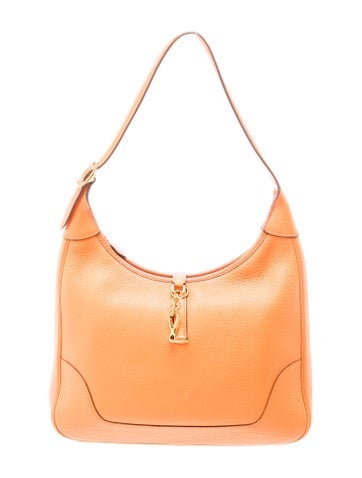
Most of the confusion around the Trim family comes from the fact that buyers use one short model name for three distinct layouts. The fastest way to sort them is to start with the bag's structure, not with its year.
The Functional Difference
- Trim I
- The leanest version. It is usually described as having no base and no zipper, so it wears like a flatter hobo under the arm.
- Trim II
- Adds a base and a zipper. That gives the bag more structure, more security, and a clearer daily-use advantage over the original.
- Trim Duo
- Splits the bag into two slim compartments under one zipper and one strap. The result feels closer to a compact organizer bag than to a vintage hobo.
What changed on the body
The earlier Trim wears closer and cleaner because there is less structure fighting the body. The tradeoff is that it can feel vague inside, especially if you carry more than a phone, wallet, and keys. Trim II stiffens the line just enough to make the bag easier to pack and much safer for commuting thanks to the zipper.
Duo 24 changes the feel more dramatically. The face is still broad, but the depth is tight and the inside is divided. That is useful if you like keeping a phone separate from a wallet, but it also means the bag punishes bulky things faster than the older single-cavity Trims do.
The status labels that matter in 2026
- Status
- Inferred current / rotational
- What It Means In Practice
- Shows up in recent price discussions and current-era resale, but not as a stable U.S. web-stock item
- Status
- Inferred current / archival crossover
- What It Means In Practice
- Appears in current-era examples and recent price lists, but shoppers should still confirm with a boutique
- Status
- Legacy / resale-led
- What It Means In Practice
- Mostly a resale buy now, with very few signals of current U.S. online availability
Sizes & Strap Drop
Hermès does not publish one clean Trim family size chart on the U.S. site, so the useful move is to triangulate repeated spec lists with resale measurements. The numbers below are the ones that showed up consistently enough to be worth using, along with a reminder that exact listing measurements always win.
- Dimensions (cm)
- 24 × 23 × 3
- Dimensions (inches)
- 9.45" × 9.06" × 1.18"
- Reported Strap Drop
- 53 cm adjustable
- Carry
- Shoulder / possible crossbody
- Dimensions (cm)
- 31 × 29.5 × 15
- Dimensions (inches)
- 12.20" × 11.61" × 5.91"
- Reported Strap Drop
- 47 cm adjustable
- Carry
- Shoulder first
- Dimensions (cm)
- 35 × 25.4 × 8.9
- Dimensions (inches)
- 13.78" × 10.00" × 3.50"
- Reported Strap Drop
- 25.4 cm adjustable
- Carry
- Shoulder
Why Trim 31 dimensions look messy online
Because sellers do not measure it the same way. Some listings call a bag Trim 30, others Trim 31, and some flip width and height depending on whether the bag is empty or relaxed. That is why the safest way to shop a Trim 31 is to treat the size name as a family label, then verify the exact listing measurements yourself.
Crossbody reality
Strap drop matters as much as bag size. Duo 24 is the only version in this guide that has a real chance of working crossbody for many people. Even then, it is not automatic. The reported 53 cm drop sounds promising, but a shorter torso, thicker coat, or seller-side adjustment can change the result quickly.
Trim II 31 and 35 are much safer to think of as shoulder bags. They sit well under the arm, which is part of their appeal, but that same carry style is exactly why they are not the right answer if your first requirement is true hands-free wear.
Pricing & Resale
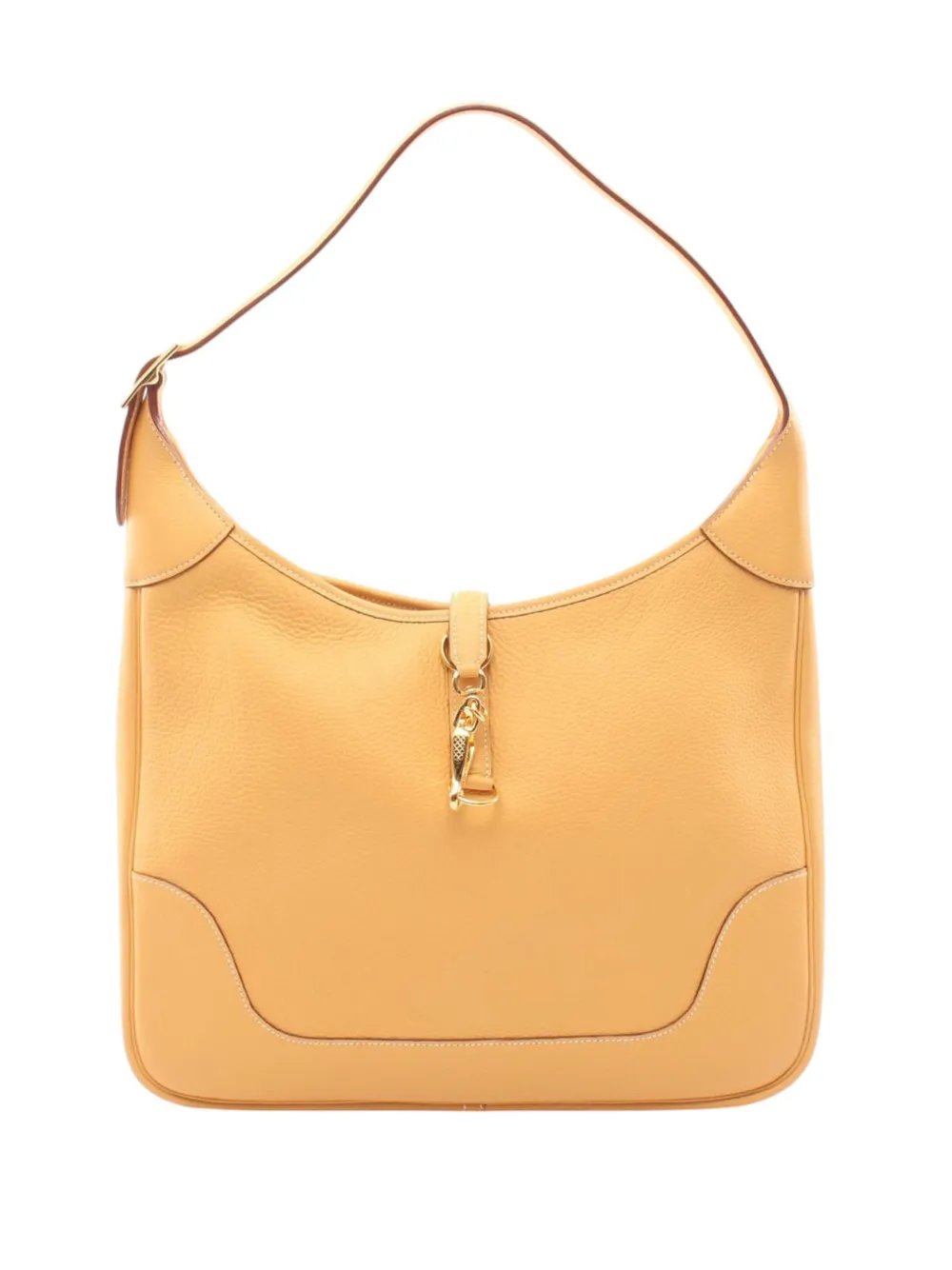
Trim pricing is messy for one simple reason: Hermès does not publish a universally accessible handbag price list, and the bag is not a stable U.S. web-stock model. So the cleanest way to talk about price is to split it into two buckets: reported boutique baselines from recent third-party price tracking, and current live resale asks we can see in April 2026.
- Leather / Material
- Evercolor
- Reported Retail
- €3,950 / £3,850
- Freshness
- Third-party list, Jan 2026
- Leather / Material
- Veau Volupto
- Reported Retail
- $6,250
- Freshness
- Third-party list, Jan 2026
- Leather / Material
- Evergrain
- Reported Retail
- $5,700
- Freshness
- Third-party list, Jan 2026
- Leather / Material
- Evercolor
- Reported Retail
- €4,250 / £4,140 / C$6,800
- Freshness
- Third-party list, Jan 2026
- Leather / Material
- Swift
- Reported Retail
- C$8,200
- Freshness
- Third-party list, Jan 2026
Those are useful planning numbers, but they are still not official public Hermès price cards. If you care about the exact current boutique number, especially outside Europe, confirm it with a sales associate before you treat any list as final.
April 2026 live resale snapshot
- Live Listings Tracked
- 7
- Observed Ask Range
- $2,595-$4,316
- Median Ask
- $3,345
- What To Know
- This is the most consistent current-era market and the easiest place to start
- Live Listings Tracked
- 18
- Observed Ask Range
- $1,225-$9,400
- Median Ask
- $1,900
- What To Know
- Standard leather bags cluster much lower than the one exotic outlier
- Live Listings Tracked
- 2
- Observed Ask Range
- $1,391-$1,995
- Median Ask
- $1,693
- What To Know
- Few live examples, but they still support the idea that larger legacy Trim is usually a sub-$2k resale buy
The Duo 24 data lines up with the examples in the research: one Fashionphile listing at $3,295 and another set of current asks stretching a bit above $4,000. The classic Trim market is looser. Once you mix old leather, unusual colors, canvas combinations, and one-off exotic pieces into the same search results, the family name stops telling you much about the real market.
The real premium drivers are not mysterious. Recent Duo bags in neutral colors with clean condition and a full set do better. Fringe or Anate versions can jump into five-figure territory because buyers treat them more like collectible statement pieces than like practical shoulder bags.
What Fits & Daily Use
Capacity is where the family split becomes obvious. Duo 24 gives you broad front dimensions but very little depth. Trim II 31 and 35 give you more room and a simpler interior. So the right question is not "Which Trim is best?" but "How flat is what I carry?"
What fits in the Trim Duo 24
- Usually works: Phone, small cardholder or compact wallet, keys, lipstick, and a small earbuds case.
- Starts to fight the bag: Thick full-size wallets, hard sunglasses cases, chunky key pouches, and stacked small goods.
- Why: The problem is not width or height. It is the slim depth and the divided interior.
What fits in Trim II 31 and 35
The larger classic Trim bags are more forgiving. A Trim II 35, with depth closer to 3 inches than to Duo 24's 1.2 inches, can handle a normal daily set much more easily: wallet, phone, sunglasses, pouch, and a few extras without flattening the whole bag.
Leather and wear
- Evercolor: Soft and supple, with more sheen over time.
- Evergrain: Printed grain, still softens with use, and usually reads a little tougher than Evercolor.
- Swift: Very supple and smooth, but it will usually show wear sooner than grained leather.
- Epsom: More shape-retaining and more scratch-resistant on the surface, though high-rub areas can still flatten the grain.
Storage and comfort
- Store slim Trim bags lightly stuffed so the body does not collapse into hard folds.
- Do not overstuff a Duo 24. The bag is flat enough that large shapes can print through the leather and distort the profile.
- If you wear thick outerwear most of the year, be more conservative about crossbody expectations for the Duo 24 and more realistic about shoulder carry on the larger Trim II bags.
Comparisons Shoppers Actually Search
- Dimensions
- 24 × 23 × 3 cm
- Carry
- Shoulder / possible crossbody
- Why You Pick It
- Compact, organized essentials bag with low visual noise
- Dimensions
- 16 × 18 × 5.5 cm
- Carry
- True crossbody
- Why You Pick It
- Sportier, lighter, and easier if hands-free carry is the priority
- Dimensions
- 28 × 28 × 9.5 cm
- Carry
- Shoulder / crossbody
- Why You Pick It
- Much more daily capacity than any Trim covered here
- Dimensions
- 18 × 14 × 6.2 cm
- Carry
- Shoulder / crossbody
- Why You Pick It
- Structured flap bag with pockets and a dressier look
- Dimensions
- ~18 × 14 × 4 cm
- Carry
- Shoulder / crossbody
- Why You Pick It
- More formal, more recognizable, and usually much more expensive
Trim vs Trim Duo 24
This is the central split. If what you want is vintage shoulder-bag energy, a classic Trim II 31 or 35 is the cleaner answer. If you want a compact daily bag with built-in separation for phone and wallet, Duo 24 is the better fit. The original Trim family feels more fluid. Duo 24 feels more deliberate.
Trim vs Evelyne
The Evelyne is the easier practical buy if you need a real crossbody. The 16 has a 116 cm strap and the 29 can run from 94 to 138 cm depending on adjustment. Both also have more usable depth than a Duo 24. What the Trim gives back is a cleaner front and a less overtly casual look. The Evelyne's perforated H and canvas strap make it sportier on sight.
Trim vs Roulis mini
The Roulis mini is the dressier small bag. It has a structured flap, a signature clasp, and both interior and exterior pocketing. Duo 24 is broader and flatter. It does not feel like a jewelry piece. It feels like a compact organizer bag.
Trim vs Constance
The Constance is the right comparison if you are deciding how much visual identity you want. The Constance is structured around the H clasp and carries the market attention that comes with it. The Trim family is quieter, less formal, and usually much cheaper unless you are buying a special edition or exotic skin. If you want the bag to be subtler, Trim makes sense. If you want the clasp to be the whole point, Constance wins.
Trim vs Bolide
Both are slim, zip-top Hermès bags without the status pressure of a Birkin or Kelly. The Bolide is rounder and softer in silhouette with a signature rolled-leather handle; the Trim Duo 24 is flatter and longer with a strap-forward design. If you want the shoulder strap as the primary carry method and prefer a compact footprint, the Trim is the closer match. If you prefer a more structured zip bag with handle carry and stronger resale history, the Bolide is worth comparing directly.
Who Should Buy It
The Trim works well if you...
- • Want an Hermès shoulder bag without loud hardware or a visible logo
- • Like close-to-the-body carry more than tote-style openness
- • Prefer older Hermès models that still feel useful rather than purely archival
- • Need zip security but do not need big daily-bag capacity
- • Are comfortable buying through boutiques or resale instead of waiting for a clean U.S. web drop
The Trim is probably wrong if...
- • You want guaranteed easy crossbody wear on every version
- • You carry bulky items every day
- • You want a bag that is easy to catch online in the U.S.
- • You prefer structured flap bags with visible compartments and pockets
- • You mainly want the Hermès bag with the strongest status signal and resale heat
Frequently Asked Questions
Related Hermès Guides
Hermès Evelyne Guide →
Read this next if hands-free carry matters more than the Trim's slimmer, cleaner shoulder-bag shape.
Hermès Roulis Guide →
The better comparison if you want a small structured flap bag with more built-in pockets and a dressier feel.
Hermès Constance Guide →
Use this if you are comparing the Trim with Hermès' more famous clasp bag and want the price difference laid out.
Hermès 24/24 Guide →
Another understated Hermès bag for buyers who care more about day-to-day function than about a headline model name.
Key Takeaways
- The Trim family is one name for several bags: Trim I, Trim II, and Trim Duo 24 do not carry the same way, and that is the first thing to sort before you buy.
- Duo 24 is the modern answer: It is the best fit if you want a compact organized bag and can live with the very slim depth.
- Classic Trim II is still the shoulder-bag answer: The 31 and 35 sizes keep the archive feel and are often materially cheaper on resale than current-era Duo bags.
- Availability is still the friction point: In the U.S., the bag is much easier to think of as a boutique or resale hunt than as a stable online purchase.